Mwalimu AI: Bringing AI to Tanzanian Schools Without Depending on the Internet
What if a teacher could use an AI teaching assistant even when the internet is unavailable?
This is the question behind Mwalimu AI, a project we are developing at UbuTechHub to explore how artificial intelligence can support education in Tanzania and, potentially, across Africa.
The project started from a simple observation: while AI is advancing rapidly, many of the solutions being developed assume that users have reliable and continuous internet access.
That assumption does not always reflect our reality.
The challenge: AI depends heavily on connectivity
In many schools and communities, internet access can be unreliable, expensive, slow, or completely unavailable.
For a teacher who wants to use AI to prepare a lesson, generate exercises, explain a difficult topic, or support students, losing internet connectivity can mean losing access to the AI system altogether.
This raises an important question:
“What if access to AI education tools did not have to depend on the internet?”
At UbuTechHub, we believe this is worth exploring.
Introducing Mwalimu AI
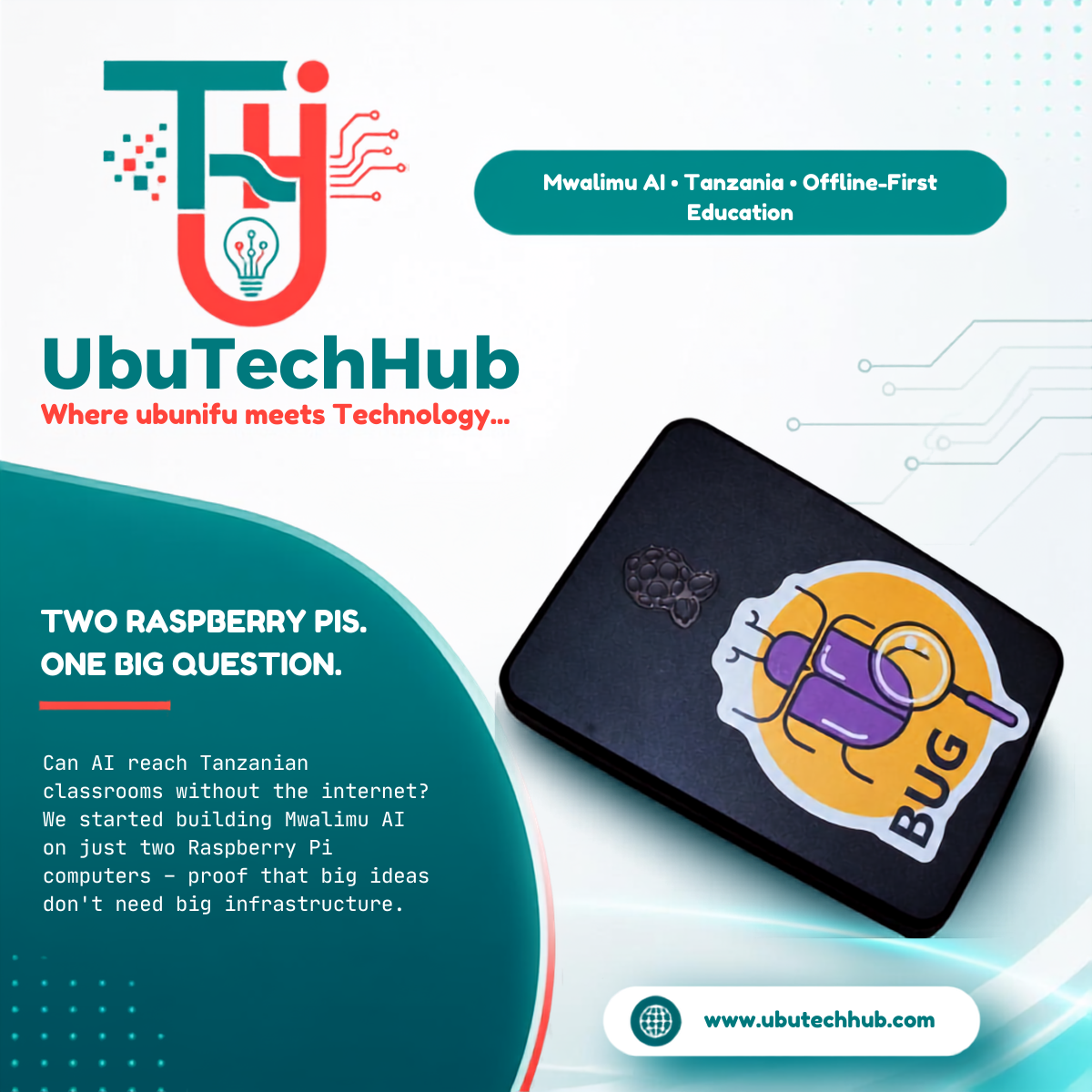
Mwalimu AI is our working prototype of an AI teaching assistant designed to operate locally.
Rather than requiring every interaction to travel to a cloud-based AI service, our approach explores running the AI on local hardware and allowing teachers and learners to interact with it through a local network.
This means the classroom could have its own local AI environment.
A teacher could connect using a phone, tablet, or computer and interact with Mwalimu AI without requiring an active internet connection.
The prototype is built around affordable hardware, including Raspberry Pi computers, as we investigate what is technically and practically possible in a Tanzanian school environment.
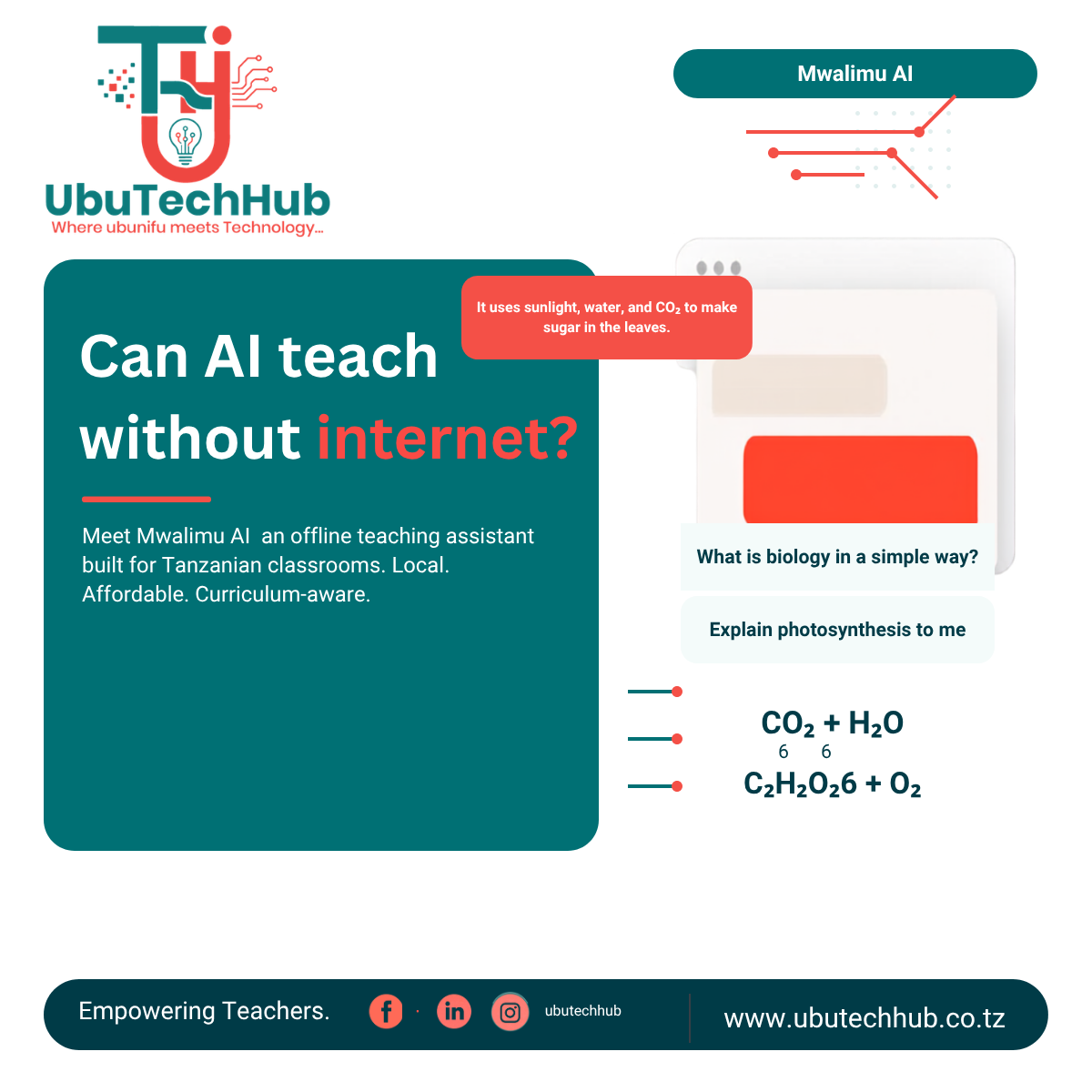
A simple classroom interaction
Imagine a teacher asking:
“"Nieleze usanisi wa chakula."”
Mwalimu AI can respond:
“"Hutumia jua, maji na CO₂ kutengeneza sukari kwenye majani."”
In English:
“"It uses sunlight, water, and CO₂ to make sugar in the leaves."”
The important part is not simply that an AI can answer a question.
The important question is whether that capability can be made available locally, affordably, and reliably in environments where internet connectivity cannot be guaranteed.
Why local AI matters
Running AI locally changes the way we think about access.
Instead of:
Teacher → Internet → Cloud AI → Internet → Teacher
we can explore:
Teacher → Local Network → Local AI → Teacher
The internet can then become an additional resource rather than a requirement for every interaction.
This approach could also provide greater control over educational content and data, particularly when working with schools and learners.
Built for the Tanzanian context
Mwalimu AI is not intended to be simply a general-purpose chatbot placed inside a school.
Our research is focused on understanding what an AI education system needs to work in the Tanzanian context.
That includes:
- Tanzanian curriculum content
- English and Kiswahili
- Local educational examples
- Affordable hardware
- Unreliable connectivity
- Limited computing resources
- Electricity and power constraints
- Teacher needs and classroom realities
The goal is to build around these realities rather than expecting the realities to change for the technology.
From prototype to research
We already have an initial working prototype of Mwalimu AI.
But a prototype is only the beginning.
There are still important questions we need to answer.
1: How well can a local AI model perform on affordable hardware?
2: How many users can a local system support?
3: How accurately can it respond to Tanzanian curriculum questions?
4: How well does it perform in Kiswahili?
5: What happens when the system operates for days without internet access?
6: How should the system update its educational content when connectivity becomes available?
7: And most importantly, does it actually help teachers and learners?
These are the questions we want to investigate through continued development and testing.
Beyond one AI assistant
Our longer-term vision goes beyond Mwalimu AI as a single teaching assistant.
We are exploring local-first AI agents that can support different parts of the education system.
A local AI system could potentially help teachers prepare lessons, create exercises, explain concepts, support revision, and work with locally available educational resources.
When internet connectivity becomes available, the system could also synchronize updates, new resources, or other information.
This creates a different model:
“Offline when necessary. Connected when possible.”
Building for Africa
The challenge we are addressing is not unique to Tanzania.
Across Africa, there are millions of learners and educators working in environments where reliable connectivity cannot be assumed.
This creates an opportunity to rethink how AI systems are designed.
Instead of asking only:
“"How can we bring existing AI solutions to Africa?"”
we should also ask:
“"How should we build AI differently for African realities?"”
That is the larger research direction behind Mwalimu AI.
What comes next
Our next stage is to continue testing and improving the prototype while learning from real educational environments.
We want to understand the technical requirements, educational value, cost, reliability, language capabilities, and practical challenges of deploying local AI in schools.
We also want to work with educators, researchers, technology partners, and schools to understand what would make such a system genuinely useful.
Mwalimu AI is still a developing project, but it represents an important step in our exploration of locally accessible AI for education.
The future of AI in education should not only work where the internet is strong. It should work where it is needed.
At UbuTechHub, we are working toward that possibility.
UbuTechHub
Where ubunifu meets Technology...
www.ubutechhub.co.tz