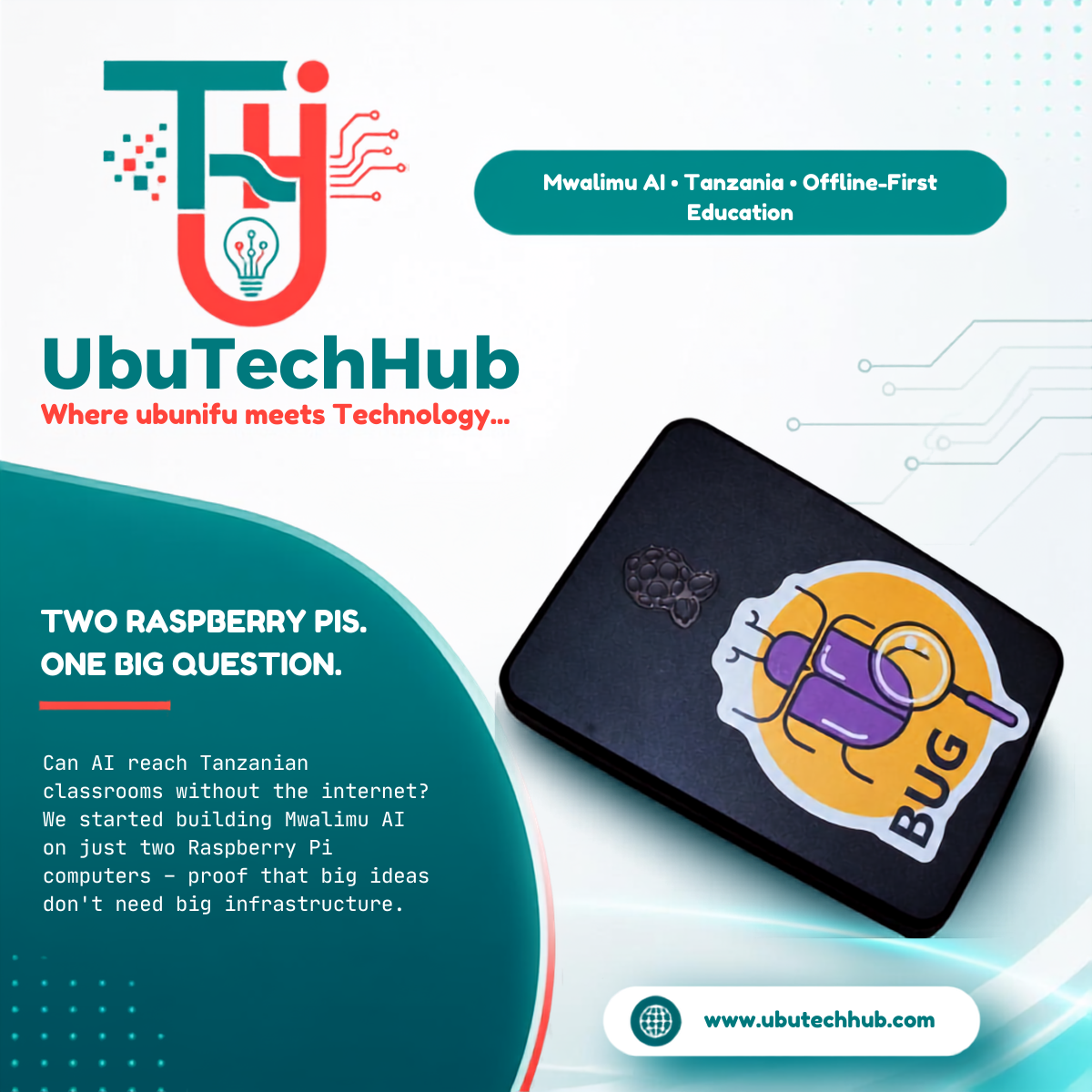
Last month, Keith MacDonald gave our team two new Raspberry Pi computers to support our work on technology and innovation projects in Tanzania.
For us, these were more than just two computers. They allowed us to experiment, build, test ideas, and explore how small, affordable computers can solve real problems in our communities.
One of the first projects we explored with the Raspberry Pis is Mwalimu AI.
The question we're exploring
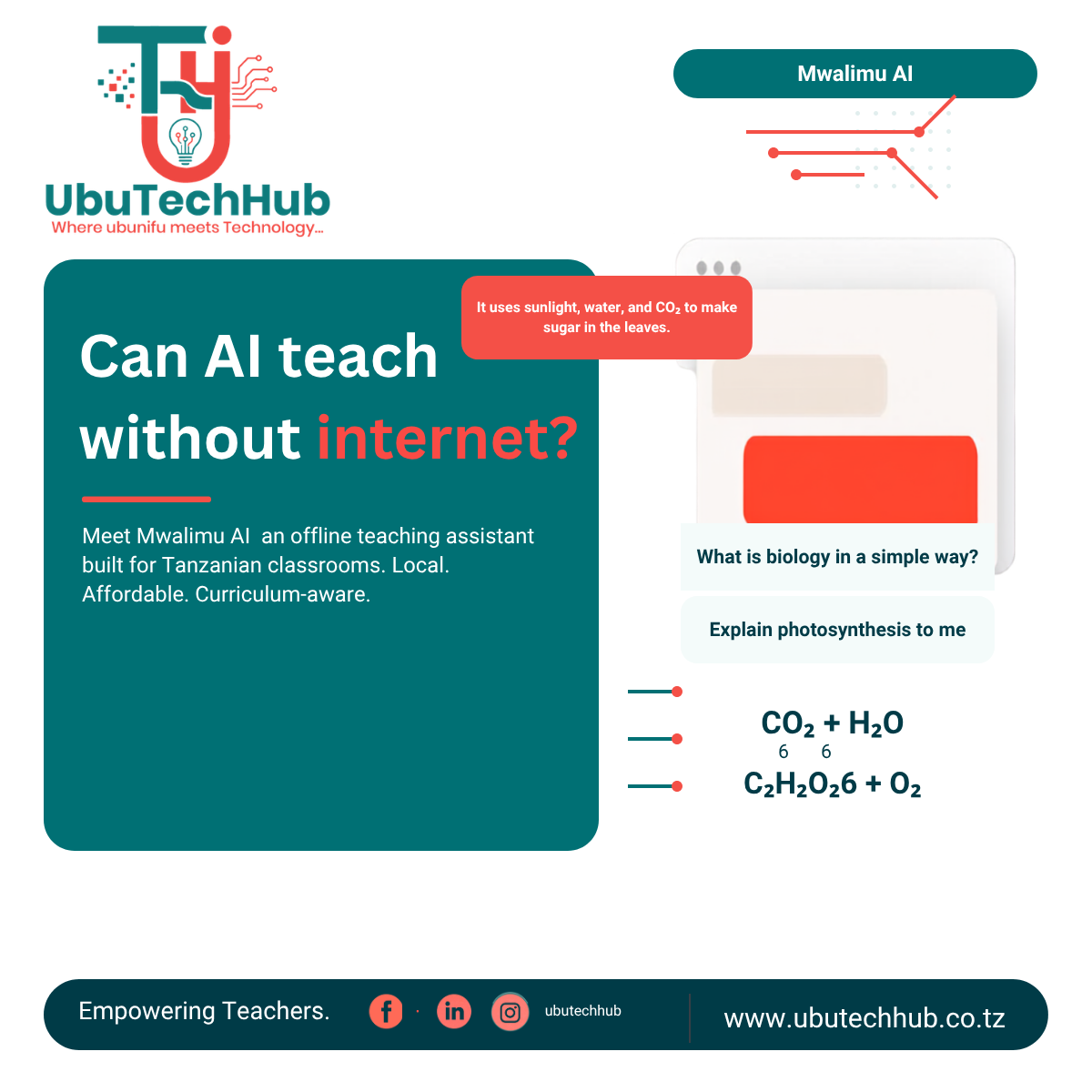
Mwalimu AI is our attempt to explore a simple question:
“Can useful artificial intelligence reach Tanzanian classrooms even when reliable internet access is not available?”
UbuTechHub Team
Why offline matters
Artificial intelligence is becoming increasingly useful in education. Teachers can use AI to prepare lesson plans, create student notes, develop exercises, generate examination questions and prepare marking schemes.
However, many of the popular AI tools depend on an internet connection. This can be a major limitation for schools where internet access is slow, expensive, unreliable or unavailable.
What we're building
Our idea is to build a small, affordable AI teaching assistant that can run locally on a Raspberry Pi. A teacher could connect to the Raspberry Pi using a phone, tablet or computer through a local Wi-Fi network, without needing continuous internet access.
We want Mwalimu AI to be relevant to Tanzanian teachers and students. The system would therefore be designed around Tanzanian curriculum materials and other educational resources, rather than simply relying on general-purpose AI.
At the moment, Mwalimu AI is still an early prototype. We are using the Raspberry Pi as a platform to learn what is technically possible, test different approaches and eventually work with teachers to understand whether such a system could be useful in a real classroom.
The two Raspberry Pis have therefore become important tools for our experimentation. They have allowed us to start building with hardware that is relatively affordable and accessible, rather than waiting until we have access to expensive computing equipment.
Part of a bigger goal
We see this project as part of a wider effort to make technology more accessible to young people and communities in Tanzania. Through our work at UbuTechHub and our YouthTech programme, we are also interested in helping young Tanzanians learn AI, programming and practical technology skills.
What's next
Our next challenge is moving from an early prototype to a system that can be tested with real teachers and schools.
To do that, we are looking for support with hardware, technical mentorship, educational resources, testing and opportunities to pilot the technology in Tanzanian schools.
We are grateful to Keith MacDonald and everyone who supports access to affordable computing technology. The two Raspberry Pis have already helped us move from ideas to practical experimentation, and Mwalimu AI is one of the first projects showing us what may be possible.
We hope to continue building, learning, and sharing what we discover so that more young people in Tanzania can use technology not only to learn about the future, but also to build solutions for their own communities.